

By Charles Maduka
For most football referees, receiving an appointment to officiate at the FIFA World Cup represents the highest point of a lifelong dream. For Somali referee Omar Artan, that dream appeared within reach before it was suddenly taken away. Yet in a twist that has captured the attention of the global football community, disappointment has quickly given way to admiration, support and an even greater opportunity.
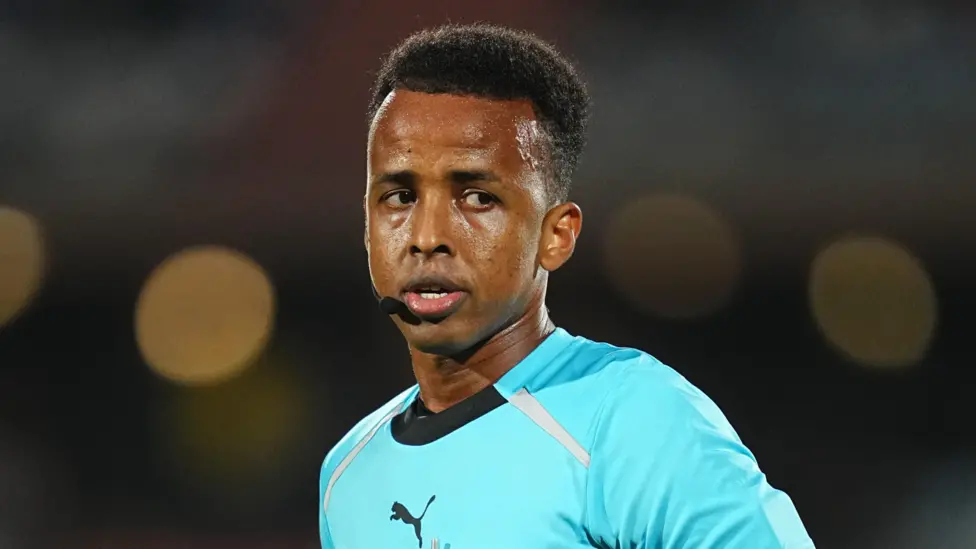
Artan’s journey to the 2026 World Cup was already historic. The 34-year-old became the first Somali referee selected to officiate at football’s biggest tournament, a milestone that inspired millions across Somalia and the African continent. His rise through the ranks of world football had been built on years of dedication, consistency and excellence in officiating.
However, shortly after arriving in Miami to join other World Cup match officials, Artan’s dream was interrupted. According to the BBC, He was detained and questioned for 11 hours by United States immigration authorities before being denied entry into the country. Despite holding the necessary travel documents and visa, he was eventually placed on a flight out of the United States and returned to Somalia.
The decision sparked widespread debate throughout the football world. Artan maintained that he had complied with all requirements and described the experience as deeply painful. “I’m just simply a referee who’s trying to live his dream, the biggest dream of my life, to come to the World Cup,” he told The New York Times, expressing the heartbreak of missing an opportunity he had worked years to achieve.
What could have become a career-defining setback instead revealed the respect Artan commands within football circles. FIFA moved quickly to assure the Somali official that he would receive his full World Cup remuneration despite being unable to participate in the tournament. The gesture was viewed by many as recognition of both his professionalism and the unfortunate circumstances surrounding his exclusion.
The support did not end there. In a remarkable show of solidarity, UEFA appointed Artan to officiate the UEFA Super Cup final between Paris Saint-Germain and Aston Villa in Salzburg, Austria. The appointment is historic in its own right, making him the first African referee to take charge of a major UEFA final. It also sends a powerful message about football’s commitment to inclusion, equality and respect.
Artan’s rise has not happened overnight. He has steadily built a reputation as one of Africa’s finest referees. In 2025, he was named the Confederation of African Football’s Men’s Referee of the Year, becoming one of the continent’s most respected match officials. That same year, he officiated the second leg of the CAF Champions League final between Pyramids FC and Mamelodi Sundowns, becoming the first Somali referee to oversee a continental final.
His growing international profile was further strengthened when FIFA selected him for the Under-20 World Cup in Chile, where he handled three matches, including the third-place playoff. He also officiated at consecutive Africa Cup of Nations tournaments, demonstrating his ability to perform consistently on major stages.
Back home in Somalia, Artan’s return was anything but quiet. Thousands of supporters welcomed him as a hero, celebrating not only his achievements but also the resilience he displayed in the face of adversity. For many Somalis, his story represents hope, determination and the possibility of overcoming barriers through hard work and talent.
Football leaders across Africa and Europe have praised Artan’s achievements. CAF President Patrice Motsepe described him as a source of pride for Somalia and the entire African continent, while UEFA President Aleksander Ceferin highlighted his outstanding officiating ability and professionalism. Their comments reflect the growing recognition that Artan’s influence now extends beyond refereeing itself.
Despite the disappointment of missing the 2026 World Cup, Artan remains focused on the future. He has already declared his intention to officiate at the 2030 World Cup, which will be hosted by Spain, Portugal and Morocco. Given his trajectory and determination, few would bet against him achieving that goal.
In many ways, Omar Artan’s story is no longer just about a referee denied entry into a country. It is a story of perseverance, dignity and the unifying power of sport. While the World Cup dream was temporarily delayed, football has ensured that one of its most respected officials remains firmly in the spotlight. Sometimes the greatest victories are not measured by matches officiated, but by the character shown when facing life’s toughest challenges.
More Stories




Join Capital Sports Updates
Get breaking sports news, match results, transfer updates and highlights directly on WhatsApp.